
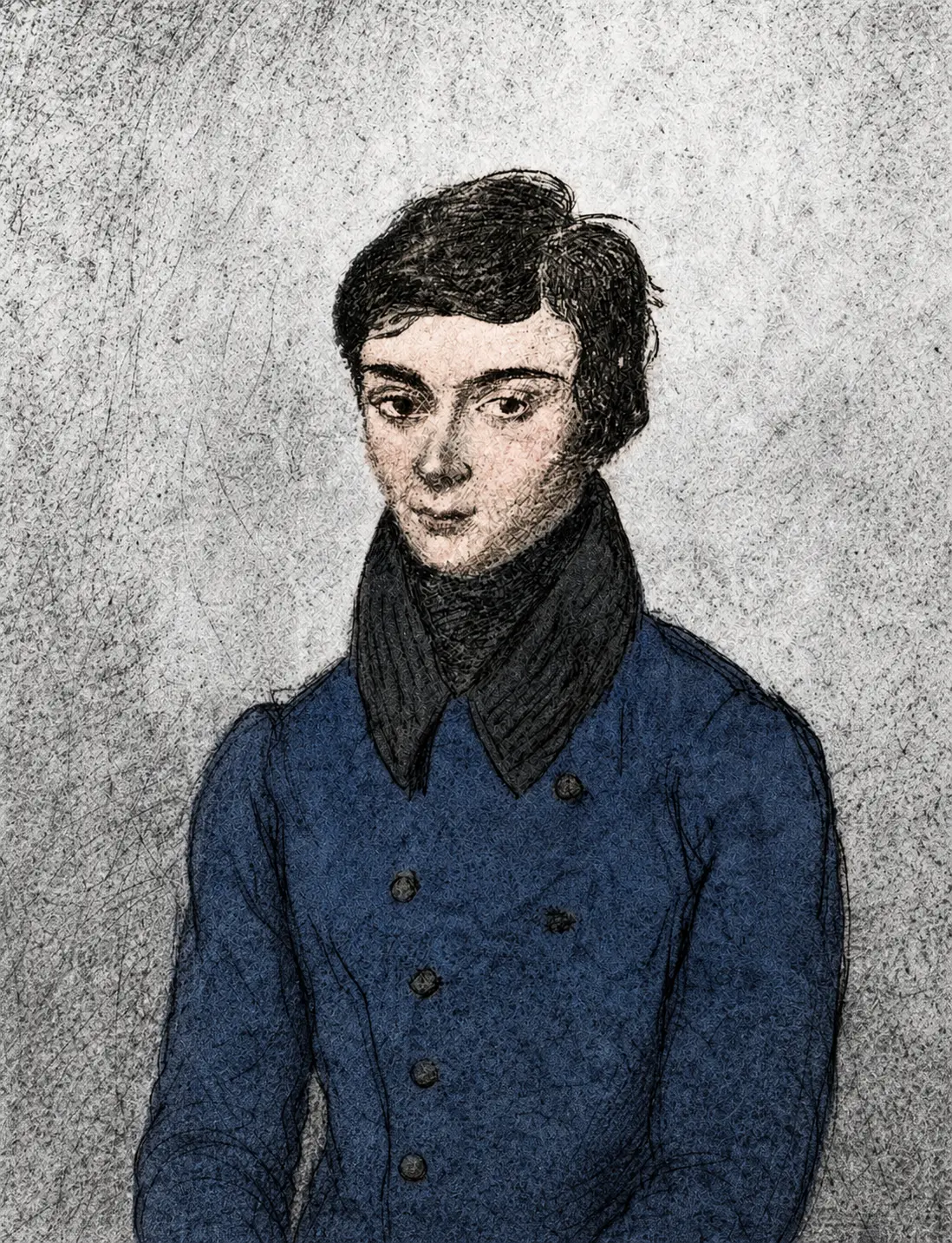
Sometimes, in history, we come across figures who defy understanding. Characters of eternal youth, battling immutable systems, with such clear vision, capable of revolutionizing thought for centuries. And all this, one man indeed managed to accomplish throughout his life in the 19th century. Embodying French panache (so dear to our national Cyrano), allow me to introduce the fabulous, the misunderstood, the dissident, named Évariste Galois.
Neither myth nor Balzacian character, he would leave his mark as one of, if not the most brilliant mathematician of all time. Dying prematurely at the age of 20, he would only be recognized for his true worth long after, for his posthumous works. And, grabbing his existence by the collar, he swore aloud to it: “As long as your flame springs forth and flickers, I swear to burn you as no one ever has!”
I — Context & Origins
The France of 1830 saw a conflict emerge in its capital between monarchists (supporters of King Charles X) and republicans (led by Adolphe Thiers). This opposition quickly degenerated, and a revolution broke out. The cause? The famous “July Ordinances,” where the king attempted to muzzle the press and dissolve Parliament. This gave rise to days of insurrection known as the “Three Glorious Days,” on July 27, 28, and 29, 1830.
It was during this pivotal moment that a brilliant young man, a convinced republican, hoisted himself to the top of a barricade. Engaged in the artillery of the National Guard and a member of the Society of the Friends of the People, he fought physically. He recalled, amidst the chaos of shouts and crowd movements, that a year earlier, to the day, his father had tragically ended his own life. Devoured by his personal distress, and caught in the infernal spiral of academic failure, he externalized all his rage there. Without apparent fear, actively participating in the clashes, he defended what he believed in. And the victory of the insurgents made the king’s fall inevitable.
18 years earlier, in the south of Paris, Évariste was born in the village of Bourg-la-Reine. From an educated family, he received an education in the capital’s best establishments. Then, at the age of 16, initiated into mathematics, a miracle occurred… He fell in adoration.
A tireless worker and eager to publish his discoveries, he would see his first works rejected, deemed “incomprehensible” and “too abstract” by his peers (Cauchy and Poisson in particular). Ignored, Évariste became unruly and rebellious. Frustration would further strengthen his rejection of overly rigid academic institutions. And, already passionately engaged in revolutionary ideas, his exacerbated activist attitude would lead to his expulsion from the École normale.
Once the July Revolution was over, left to his own devices, he would face legal troubles. The first time, he gave an "ironic" toast to Louis-Philippe (the new king of the French) at a republican meeting. Weapon in hand, he cried out (brandishing the knife): "To Louis-Philippe, if he betrays," (an episode recounted in the memoirs of Alexandre Dumas père), which was taken as an incitement to regicide. The next time, arrested on the Pont-Neuf during a demonstration, he was convicted of illegal possession of a weapon (a loaded pistol). The sentence fell: 6 months imprisonment in La Santé. Out of the system since his fall from the school system, it was now society's turn to cast him out.
II — Works and Death
Despite a very turbulent life, he would find the time to redesign the "queen of subjects" that are maths and to give birth to remarkable theorems:
First, he worked on polynomial equations. He discovered that symmetries exist between the roots of an equation. By highlighting them, he made it possible to better understand why certain equations can be solved using square roots.
Also, tired of constantly rewriting all formulations in their entirety, he streamlined the intermediate terms to make equations much more readable. This was not merely about aesthetics, but about better grasping mathematics. Accustomed to thinking outside the box, he made this method acceptable and named these equations "normal."
But what would enshrine him in the pantheon of algebra are his works on the theory of finite fields or "Galois fields." Through this, he endowed mathematics with a finite dimension, which would serve as a fundamental basis for number theory (which itself would influence cryptography; and much later would be used as a basis for computers, then the entire digital world).
Resistant to academic conformism, Évariste, for his part, advocated for a more "frank and collaborative" science. And his ability to think outside the box (to use an anglicism) was the driving force of his entire philosophy.
Some will see in Galois a troubled soul, merely seeking confrontation for its own sake to get noticed. But this permanent "no" that he hurled at institutions is not the "screw you" of a stunted adolescent; quite the contrary. This refusal demonstrates the boy's ability to challenge vertical structures and regimes, as well as mentalities of acceptance and servility. In short, he is the middle finger extended to the status quo.
And did time prove him right? You be the judge.
But whatever the case, the figure of Évariste remains a mystery to us concerning the last episode of his life.
He has been out of prison for a few days now and, on the night of May 29, 1832, he knows that his destiny awaits him the next day. Provoked into a duel over a romantic affair, he uses this night to gather his writings, his thoughts, his theories, and sends everything to his friend Auguste Chevalier.
Then, in the early morning, amidst dismal pond mists, on the outskirts of Paris, with his back to the man from whom he refused to apologize, he would advance 25 paces. Turning around, a gunshot rings out. Standing, motionless, he feels a viscous liquid spread across his lower abdomen.
Left on the spot, he would die shortly after at Cochin Hospital. The announcement of his death would cause a local stir, uniting republicans for a time. Then, gently, the legend of the cursed genius, gone too soon, would begin…
“After this, I hope there will be people who will find it profitable to decipher all this mess,” he would write as the last sentence of his will.
III — Legacy, Justice and Infusions of Courage
His writings would be kept and even forgotten by his comrade Chevalier, who, in turn, would transmit them to Joseph Liouville (also a mathematician) in 1843, who would publish them immediately. Thus rehabilitating the dusty papers for a deserved posterity. The world would bear witness to the impact of his discoveries.
Beyond the purely cerebral, my fascination with Galois comes from his constant ability to “save face” (as our Japanese friends know so well how to do). To live in accordance with his principles and to have decided, come hell or high water, not to live like a coward. Cowardice? A concept he was ignorant of!
As Nassim Nicholas Taleb explains in his book “Skin in the Game”, Évariste embodies one who took all risks. This, not by virtue of a fantasized future glory; absolutely not, but out of dignity, rectitude, and consistency with himself.
It is certain that his inspiration contrasts sharply with postmodernity. These new times are distinguished by their Kafkaesque judicial system, their Alps of paperwork, and where the slightest hint of conflict brings in the third party, “Daddy State.”
A firm handshake then served as a guarantee. And one whose word wavered (the charlatan) was ostracized. The system (though imperfect nonetheless) regulated itself, because it rested on a solid common foundation. And visibly, in this era where respect is no longer at the forefront of concerns, two centuries ago, a young man kept his chin up to avoid dishonor. Participating in an expeditious “underground” justice, he saved his honor at the cost of ultimate sacrifice.
He teaches us, through his personality (and his way of operating), that every action must have a profound meaning, one that is personal to us. And that these actions, when they are the fruit of a boundless love, a passion without measure, without calculation or ulterior motives, will positively influence the collective. And the entire universe will conspire to do justice to our causes.
Conclusion
His life could have ended atop a barricade, stabbed in an amphitheater by radical dissenters, or by losing his mind on the razor's edge like so many geniuses. But it ended by the side of a brook. And in the sad mist, his abdomen perforated, I sometimes wonder what Évariste must have whispered to himself, a simple, smooth "is that all?".
His actions, at times grandiose, at times puerile, resonate like the absurd youth of those who seek to find. It is difficult to pronounce judgment on his case; did he truly find?
One thing is certain, his legacy is more relevant than ever. His story resonates with this generation that is searching for itself, that is trying to see through omnipresent screens, and escaping the nets of foolishness. He speaks to sincere people, to those who fight against injustice, to those who question what is imposed without authorization, to those who know how to reason and to question themselves.
Évariste could not stay silent and acquiesce like a common passive spectator. And with all the endearing flaws of inexperience, until the last second of his existence, he breathed the raw sense of justice.
His speeches, his decisions, and his actions elevated his soul. Yes, Évariste showed us the way. And from the height of his 20 too-short springs, he delivered an unstoppable uppercut to the pedantic intelligentsia and the despotic regime in which he moved; overturning the table of prejudices!
"Oh, Évariste. I implore you; you, guide of thinkers, point your solitary finger towards the meanders. They will prove subtle, violent, but comprehensible… You, the uncertain tomorrow, what humility you showed in adversity. Give us the strength to approach it. In the meantime, take this salutary rest, you truly deserve it."
— This is my ode to Évariste Galois.
Your servant
Nicolas.