Between speculative movements and raw reality, there is often only a single step. The punk worlds and their literatures are its perfect embodiments. These currents of imagination try to anticipate uncertain tomorrows. We speak of them as speculative fiction, and their aesthetic universes are both numerous and strikingly divergent.
But be careful: we will deal here with movements of anticipation, not with technological or historical uchronia, such as Steampunk, a true retrofuturism (in which steam engines would have come to dominate the industries of the Victorian era), or alternative historical dramas built on questions like: “What if the Third Reich had won the Second World War?”. The idea is to explore conceivable futures, not alternative versions of the past or present.
Let us not confuse the two.
So let us dive into this multitude. These universes, created by artists as much as by whistleblowers, attempt to show the fate of a humanity following certain societal paths.
There are several worlds, more or less credible, among them: Biopunk, with its biotechnologies and genetic engineering capable of transforming the human genome. Nanopunk, and its programmable molecules and atoms capable of disintegrating living matter, atom by atom. Oceanpunk, in the manner of Waterworld, where planet Earth would be submerged by water, its floating cities having industrialised fishing on a vast scale. And finally Desertpunk, with continents of sand à la Mad Max, where tribal societies would regain the upper hand.
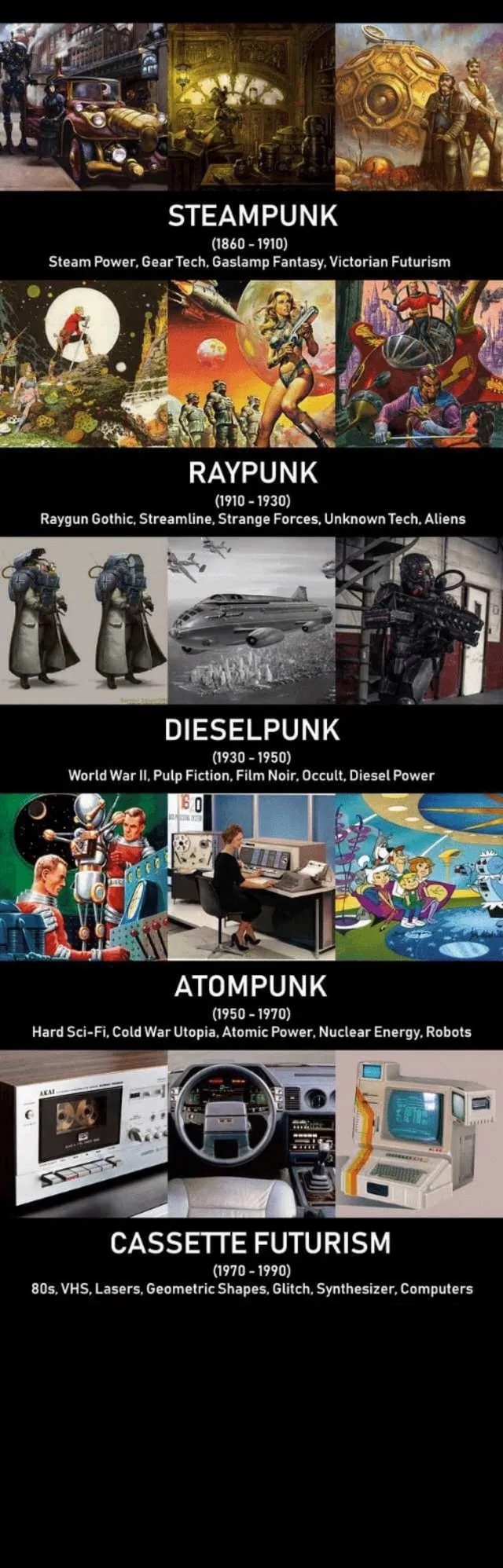
But all those mentioned above are in fact sub-genres. There are two others, far more famous, which have now passed into popular culture, and whose depictions are no doubt plausible scenarios.
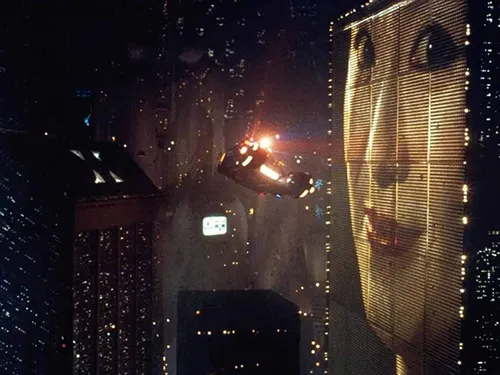
First, Cyberpunk. Halfway between Orwell’s 1984 and futuristic cities in the style of Neo-Tokyo (as in the anime Akira), we move through a world of neon skyscrapers looming over the slums. Never seeing daylight, inhabitants condemned to permanent survival have total obedience imposed on them by state institutions. Mass surveillance, brain chips, mechanised bodies: the individuals of this world retain little that is human, so thoroughly have they become semi-robotic humanoids.
This society is governed by faceless mammoth corporations that carve up the economic pie between them: transport, food, housing, entertainment, and so on. We find this concept in the video game Cyberpunk 2077 and in the Blade Runner films (released in 1982 and 2017 respectively). This world, however exaggerated, is not so far from the reality of contemporary cities. If one pushes the metaphor, the comparisons could already be many today: easy entertainment and brain chips in our widespread addiction to phones, mass-produced food in supermarkets and fast-food chains, and artificial-intelligence companies (whose valuations are inflated with the speculative helium of states) vying for a monopoly on creativity, research and everyday automated tasks. They are all around us.
This disaster scenario, in which humanity has lost what made it so unique, finds its antithesis in Solarpunk.
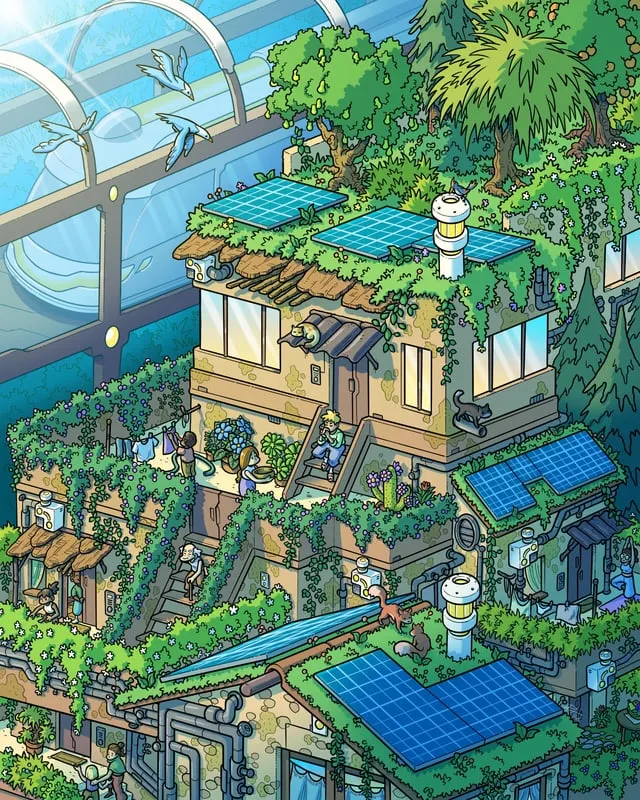
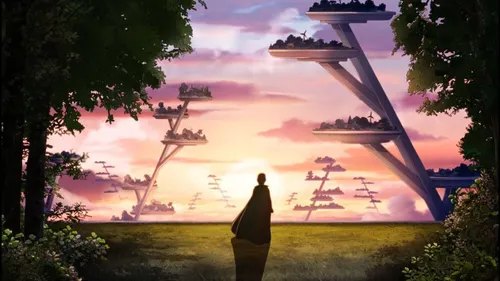
Solar, meaning “solar energy”, is an optimistic future in which renewable energies are used so that people can achieve self-sufficiency. Solar panels, healthy food, permaculture, bio-inspired architecture: here technology is put to good use for the common good.
Other renewable sources are present too, such as wind and hydropower. Famous works like Miyazaki’s Castle in the Sky or Cameron’s Avatar illustrate it.
The “punk” refers to a constructive resistance to the status quo, through a “freer” way of life that does without third parties for basic needs. The watchwords are mutual aid, community cooperatives and social justice. Some will see in it (rightly) a ZAD 2.0, but the movement runs much deeper than that. This is why I wanted to attempt a somewhat daring parallel with a phenomenon that has been unfolding for some years now: the urban exodus.
What exactly is the urban exodus?
— The expression “urban exodus” is formed by analogy with the rural exodus. The latter describes the flight of country people in the 1960s–80s to find industrial or service work in the cities. According to INSEE, nearly 8 in 10 people lived in an urban unit in 2017*. Some departures to the countryside now run the other way, without amounting to a general reversal of this distribution*.
The urban exodus drew renewed attention in 2020, when people fled cities and their “chicken-coop” flats for a patch of nature, the root of their existence. Some opportunists saw it only as a way to escape the hellish lockdown for a while. But others developed a taste for it. Research nonetheless shows moves towards small towns and rural areas*. Today, 33% of the French population lives in rural areas*.
The causes and meaning of this phenomenon?
— Beyond the 2020 trend, this drive for autonomy has other causes:
First, remote work has helped people stop enduring the city and its downsides (traffic jams, pollution, overcrowding and social tensions). These are the “neo-rurals”, who live in the countryside while working remotely. It is a rejection of the commute-work-sleep routine, or the “rat race”, as provocateurs would put it.
Second, the desire to free oneself from the State and its grip: wanting to educate one’s children far from school systems more concerned with profitability than fulfilment, through home schooling, for example.
Finally, cheaper housing per square metre and accessibility for first-time buyers. This makes it possible to set up projects such as eco-villages, favour short supply chains, and build or restore abandoned homes. All these arguments are concrete ways of taking the leap towards a calmer existence.
What links Solarpunk and the urban exodus?
— Although Solarpunk refers above all to greening existing cities, the most obvious link between the two notions is the return to nature, whether through greening concrete cities or through a radical change of life and a permanent move to the countryside.
They share other points of convergence, such as a legitimacy grounded in serious family projects. They share the desire to build stable, close-knit communities, to do politics differently, in the manner of cooperatives, and to value craftsmanship, wholesomeness and the local.
I should also point out that “village” Solarpunk, the return to nature for city dwellers, is an idealisation, and it has its downsides. Rural life is no rest cure, and great effort is needed to bring one’s projects to fruition. Before leaving the city, one must often weigh factors such as local employment, access to healthcare and the difficulty of settling in the countryside. This movement, I repeat, is above all a showcase aimed mainly at young urbanites.
The idea can be sold, but sometimes at the expense of the people of rural areas. This exodus accentuates the notable cultural differences between long-established inhabitants and newcomers. Not to mention rising property speculation and the gradual loss of village atmosphere to a globalised “gentrification”.
Greenery can be seen either as a backdrop or as a lived, everyday reality.
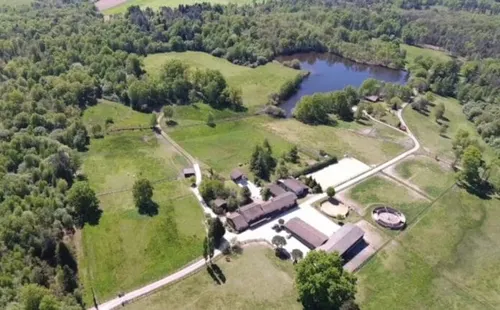
I wager that two societies, mirroring the two famous punk universes seen above, will take shape in the future. On one side, world-cities such as Hong Kong, New York or Chongqing (China); on the other, cities like Singapore (a green world-city), Almere (in the Netherlands) or the eco-village of the Beauce (Eure-et-Loir, France).
[[images:4,5]]
So even though the punk worlds are paroxysmal representations that anticipate the best as well as the worst, let us not forget that they remain exaggerations. Even so, some of their elements will indeed be part of the daily lives of tomorrow’s people.
Individuals will make their choices according to their surroundings and their desires. I nevertheless stand by my view of a possible territorial divide in France and in other countries. But a more connected generation might gradually erase certain clichés: young urban and rural people have sometimes met through screens before ever meeting in person or settling in the countryside. These ties could ease the future arrival of city dwellers in rural areas and help reduce discord, leading (perhaps) to a relative convergence of values.
In conclusion, ways of living, consuming and thinking could grow more opposed, to the point of recalling the dystopian depictions of Cyberpunk and the utopian ones of Solarpunk. But these imaginaries do not dictate our future. Let us keep hope that new generations will move beyond prejudice and make their ties a bridge between territories rather than a new fault line.
Thank you for reading to the end. I focused here mainly on Solarpunk, which is, all things considered, a positive universe. I did so because it is essential not to sink into negativity and always to see the glass half full, which explains this choice. But the resonance between urbanism and Cyberpunk is also a legitimate question, and I may address it in another article.
Your Servant,
Nicolas.
(Sources)
(* — Urban units — nearly 8 in 10 people in 2017: https://www.insee.fr/fr/statistiques/4806684)
(* — Mobility after the health crisis — small flows, no massive national exodus: https://popsu.archi.fr/programme/exode-urbain)
(— Rural population — 33% and density-based definition: https://www.insee.fr/fr/statistiques/5039991?sommaire=5040030)